Drive through any Gwinnett County neighborhood the morning after a serious storm and you will notice a pattern. The trees lying across roofs, driveways, and power lines are, more often than not, tall pines. Specifically, loblolly pines, the towering evergreens that dominate the skyline all over Lawrenceville and the surrounding area.
It is not bad luck, and it is not random. Loblolly pines fail in storms for a combination of reasons rooted in how they grow, where they grow, and what we have built around them. Understanding why can help you spot a risky tree on your own property before the next round of weather does it for you.
Gwinnett Is Loblolly Country
Loblolly pine is the most common and commercially important pine in the Southeast, and it grows across nearly all of Georgia. Much of Gwinnett County was pine forest and timberland before the subdivisions arrived, and when land gets developed, plenty of those mature pines are left standing right next to the new homes. The result is a county full of large, decades-old loblollies towering over houses, fences, and driveways. When there are that many big pines that close to structures, storms find them.
Built to Grow Fast, Not to Stand Alone
Loblolly pines are fast growers that shoot up tall and straight, carrying most of their foliage in a crown high at the top of a long, slender trunk. In a dense stand, that shape works: the trees shelter one another and share the wind load. Individually, though, that same shape is a liability. A tall trunk with a heavy crown up top acts like a long lever, and high wind pushing on the canopy puts tremendous force on the trunk and roots far below.
Because loblollies are relatively shade-intolerant, they also tend to grow up reaching for light rather than building the wide, sturdy, low structure of a more open-grown tree. Fast growth and height are exactly what makes them valuable timber, and exactly what makes them vulnerable in a storm.
The Root of the Problem: Shallow Anchorage in Saturated Clay
Two of the most common ways trees fail in a windstorm are limb breakage and windthrow, meaning the tree is uprooted or broken by the wind. As University of Georgia Extension explains, windthrow is closely tied to shallow root systems, and it becomes far more likely when strong winds arrive with or right after heavy rain.
This is where Gwinnett’s soil works against these trees. Central Georgia’s clay holds water, and when the ground is saturated and soft, it loses its grip on the root plate. A pine that would stand fine in a dry blow can tip over, roots and all, once the soil around those roots turns to mud. Add in the naturally shallower, plate-like rooting that pines often develop in compacted or confined suburban soils, and you have a tree that is only as stable as the ground it is standing in. After several days of rain, that ground is exactly where you do not want it to be.
When the Neighbors Disappear
Here is a factor specific to developing areas like Gwinnett. A loblolly that spent thirty years growing up inside a crowded stand relied on its neighbors to break the wind. When a lot is cleared for construction, or a stand is heavily thinned, the pines left behind are suddenly exposed to wind they never had to face before. They did not grow the trunk taper or root spread to handle it alone, and the first few big storms after clearing tend to take the most exposed survivors. If trees were removed near your pines in recent years, the ones still standing may be carrying loads they were never built for.
Why Pines Snap Instead of Bend
Not every failure is an uprooting. Loblolly pines are also prone to snapping partway up the trunk under heavy wind or ice load. Compared with longleaf pine, which tends to be more wind-firm and to lean or tip rather than break, loblolly and slash pines are more likely to shear off. A pine that snaps thirty or forty feet up can do just as much damage as one that comes down at the roots, and it often gives even less warning.
Construction Damage That Shows Up Years Later
One of the most overlooked causes of pine failure has nothing to do with the storm itself. When driveways, additions, pools, trenches, or grading disturb the soil near a tree, they can sever or smother the roots that anchor it. The tree may look fine for years, then blow over in a storm long after the work was done. Root damage from construction within roughly twenty feet of a trunk can set up a failure more than a decade later. If your pines have had digging or heavy equipment near them at any point, their anchorage may be quietly compromised.
Pests and Rot That Weaken Pines
A stressed or declining pine fails more easily than a healthy one. Southern pine beetles and Ips beetles can kill a loblolly in weeks, fungal diseases attack the roots and trunk, and older pines commonly develop internal decay that hollows out the wood and undermines the trunk’s strength. A tree weakened from the inside or already dying is a prime candidate to come down in the next blow, often with no obvious warning from the outside.
Warning Signs Your Pine Might Be at Risk
Before storm season, walk your property and look for:
- A lean that is new or getting worse
- Soil heaving, cracking, or lifting on one side of the base, a sign the root plate is moving
- A dead or thinning top, or fewer needles than the pines around it
- Beetle signs: popcorn-like blobs of pitch on the bark, small holes, or fine sawdust at the base
- Fungal growth or mushrooms at the root flare
- Cracks or seams in the trunk
- Pines that were recently exposed when nearby trees came down
- Any pine that has had construction, trenching, or grading near its roots
Any one of these is worth a closer look. Several together is a reason to act before the weather does.
What You Can Do Before the Next Storm
You cannot control the wind, but you can control what is standing next to your house when it arrives. The most effective steps are straightforward: have questionable pines evaluated by a professional, remove genuinely high-risk trees proactively rather than waiting for them to fail, and protect the roots of the pines you keep from future construction damage. If you have a stand of pines, avoid thinning them all at once, which leaves the survivors suddenly exposed.
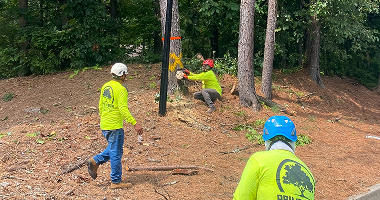
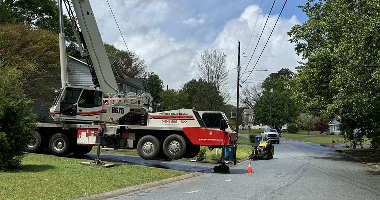
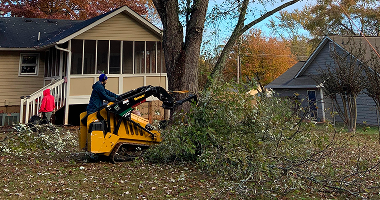
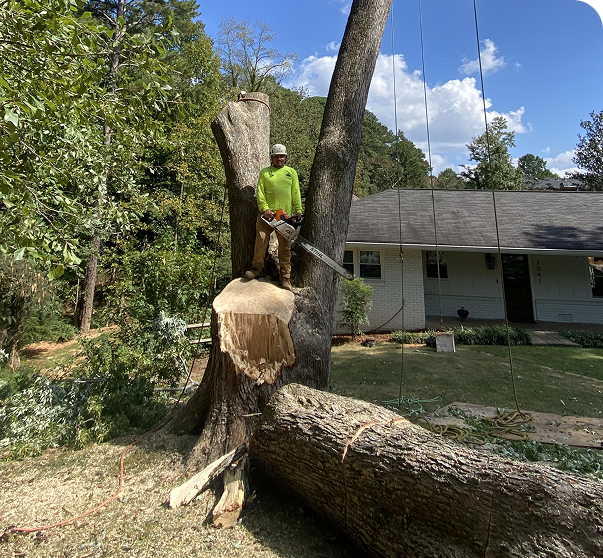
When a pine is leaning over your roof or showing the warning signs above, that is the moment to bring in a crew that can take it down safely before a storm does it the hard way. Our team handles hazardous pine removal across Gwinnett County, using rigging and crane support where needed to bring big, unstable trees down in a controlled way that protects your home and everything around it.
A pine that fails on its own schedule chooses the worst possible time and the worst possible landing spot. Dealing with a high-risk tree ahead of the storm is almost always cheaper, safer, and less stressful than cleaning up after it. If you have a loblolly you are worried about, reach out to Prime Arbor Tree Specialists for a free estimate, and we will tell you honestly whether it needs to come down.